How to Track Brand Mentions in ChatGPT (Without Guessing)
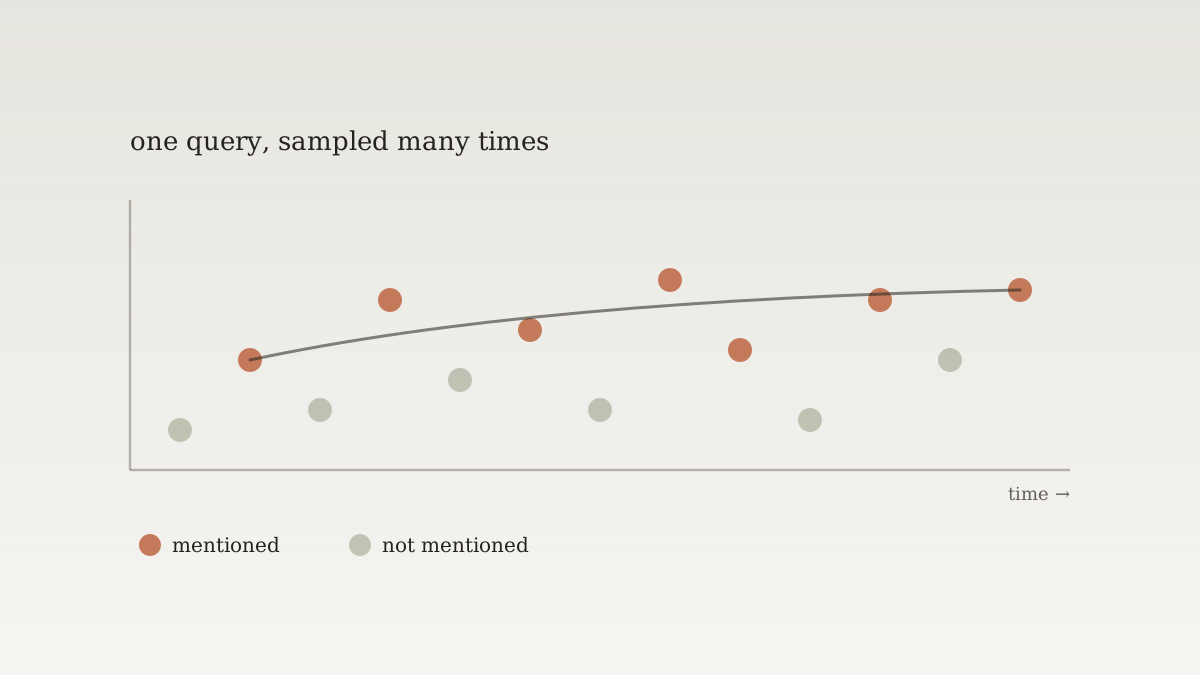
To track brand mentions in ChatGPT properly, you have to sample the same question many times, not ask it once. ChatGPT's answers are stochastic, meaning the same prompt can name your brand in one response and skip it in the next, so a single check is closer to a coin flip than a measurement. The reliable method is to run each of your priority questions repeatedly, record how often your brand appears, and repeat that on a schedule so you can see the trend move. You can do this by hand for free, and this post shows you exactly how, including the limits of the manual approach. Then it covers the rigorous version and how tools like Lectern automate it so you are tracking a real signal instead of guessing.
Why a Single ChatGPT Check Is Worthless
Ask ChatGPT "what's the best project management tool for agencies" today, and ask it again tomorrow, and you will often get different brands. That is not a bug. AI responses are stochastic: retrieval varies, context varies, and providers update models constantly, so identical prompts produce different answers across runs.
This means one check tells you almost nothing. If your brand appears, you do not know whether that was typical or lucky. If it does not appear, you do not know whether you are genuinely invisible or just caught a bad roll. A single sample gives you false confidence in either direction. The entire discipline of tracking AI visibility exists to solve this one problem. You cannot observe a distribution by looking at a single point, and a brand's presence in AI answers is a distribution, not a fact.
The Manual Method (Free, With Real Limits)
You can start tracking today with nothing but a ChatGPT account and a spreadsheet. Here is the honest version.
- List your priority questions. Write 10 to 20 questions your buyers actually ask, phrased naturally, covering your category, comparisons, and use cases.
- Run each one several times. Paste each question into a fresh chat, run it five to ten times, and start a new session each time so history does not bias the result.
- Record the outcome. For every run, note whether your brand appeared, where in the answer it landed, and which competitors showed up alongside you.
- Repeat on a schedule. Do the whole set again in two to four weeks so you have a before and after.
The limits are real. This is slow, it does not scale past a handful of queries, and your spreadsheet has no memory beyond what you type into it. You are also sampling by hand, so it is easy to cut corners and run each query once, which puts you right back to guessing. The manual method is a fine way to feel the variance for yourself. It is a poor way to run an ongoing program.
The Rigorous Method: Sample, Track, Repeat
The reliable version is the manual method done with discipline, and it rests on three ideas.
Sample enough to smooth the noise. Running a query once is guessing. Running it seven or more times per check gives you a mention rate, which is a number you can trust and compare over time. More samples reduce visible variance at higher cost, so there is a real tradeoff to tune, but anything below a handful of samples is not measurement.
Explain the variance, do not hide it. When your mention rate moves from one check to the next, the useful output is not just the new number. It is the reason. Of the samples that changed, how many, and is the shift consistent with a provider model update, a new competitor, or ordinary sampling drift? Variance you can explain is a signal you are paying to track. Variance you cannot explain looks like a broken tool.
Track over time, and per model. A snapshot is far less useful than a trend line. And do not assume ChatGPT stands in for every assistant. Research on AI search found only about 11% overlap in the domains ChatGPT and Perplexity cite, so a brand strong in one can be absent in another. Track each model your buyers actually use.
Track Each Model Separately
Because AI assistants pull from different sources and cite different pages, your visibility can look completely different depending on where you check. Treating "AI visibility" as one number hides this.
| Model | Primary audience | Why track it separately |
|---|---|---|
| ChatGPT | Broad consumer and professional | Largest reach; leans on Wikipedia and a wide source mix |
| Perplexity | Research and comparison shoppers | Leans heavily on Reddit; only ~11% source overlap with ChatGPT |
| Google AI answers | Everyday searchers | Uses the standard index; balanced source distribution |
| Claude, Grok, Meta AI | Technical, social, and in-app audiences | Different source diets again; a strong brand in one can be missing in another |
The practical rule: pick the models your customers use, track each one on its own, and do not let a strong ChatGPT number lull you into thinking you are covered everywhere. Being cited by ChatGPT and invisible in Perplexity is a common and expensive blind spot.
How Lectern Automates This
Doing the rigorous method by hand across several providers and dozens of queries is more work than most teams can sustain, which is exactly the gap Lectern was built to close. It runs your priority questions across ChatGPT, Claude, Gemini, Perplexity, and Google AI Overviews, samples answers repeatedly, and tracks your mention rate over time so you see the trend instead of a single roll of the dice.
It also does the part the manual method cannot: when a grade moves, it shows you which sample responses changed and why, so variance reads as insight rather than noise. You do not have to take our word for how the output looks. Our public catalogue of reports shows real visibility runs you can read through before you sign up for anything. Lectern's Hobby tier is free, so you can replace the spreadsheet without replacing your budget. If you are just orienting yourself, our AI visibility audit guide is a good next read.
The Bottom Line
Tracking brand mentions in ChatGPT is not about asking once and reading the answer. It is about sampling the same questions enough times to get a real mention rate, explaining the variance when it moves, and doing it across each model your buyers use, on a schedule. You can absolutely start by hand and for free, and you should, if only to feel how much a single answer swings. But an ongoing program needs repeated sampling and memory, which is where automation earns its keep. Either way, the goal is the same: stop guessing whether AI recommends you, and start measuring it.
Frequently Asked Questions About Tracking ChatGPT Mentions
Can I track brand mentions in ChatGPT for free?
Yes. Open ChatGPT, run each of your priority questions several times in fresh sessions, and record whether your brand appears in a spreadsheet. It costs nothing but time. The limits are that it does not scale, has no memory, and tempts you into running each query only once, which is unreliable. Lectern's free Hobby tier automates the same process if you outgrow the manual version.
Why do I get different ChatGPT answers to the same question?
Because AI responses are stochastic. Retrieval varies, conversation context varies, and providers update their models frequently, so the same prompt can name different brands across runs. This is why a single check is unreliable and why you have to sample a question many times to get a trustworthy mention rate.
How many times should I sample each query?
Enough to smooth out the noise. Running a query once is guessing. Sampling it seven or more times per check gives you a mention rate you can compare over time. More samples reduce visible variance but cost more, so it is a tradeoff to tune, but anything below a handful of samples is not real measurement.
Should I track ChatGPT and Perplexity separately?
Yes. Research found only about 11% overlap in the domains ChatGPT and Perplexity cite, so your visibility can be strong in one and absent in the other. Treating AI visibility as a single number hides this. Track each model your customers actually use on its own.
What is "chatgpt rank tracking"?
It is the practice of monitoring how often and how prominently your brand appears in ChatGPT's answers to your priority questions over time. Unlike Google rank tracking, there is no single ranked position, so it is measured as a mention rate across many samples rather than a spot on a results page.
What's the difference between the manual and automated methods?
The manual method is free and good for feeling the variance firsthand, but it is slow, does not scale, and has no memory. The automated method samples many queries across multiple models on a schedule, tracks the trend, and explains why a grade moved. Lectern does the automated version and publishes example output in its public reports catalogue.
Lectern helps growth-stage brands improve how they appear in AI search. We measure recommendations and citations across ChatGPT, Claude, Gemini, Perplexity, and Google AI Overviews, benchmark you against competitors, and connect the gaps to approval-gated content and publishing workflows. See how it works.
Written by

Edgar Li
Cofounder at LecternEdgar is a cofounder at Lectern, helping growth-stage companies teach AI models to accurately represent and recommend their products - turning that visibility into high-intent traffic and revenue. A product builder who thinks in narrative and customer value, he now applies that lens to helping founders win in AI search.