Lectern vs Profound: Which AI Visibility Tool Fits You?
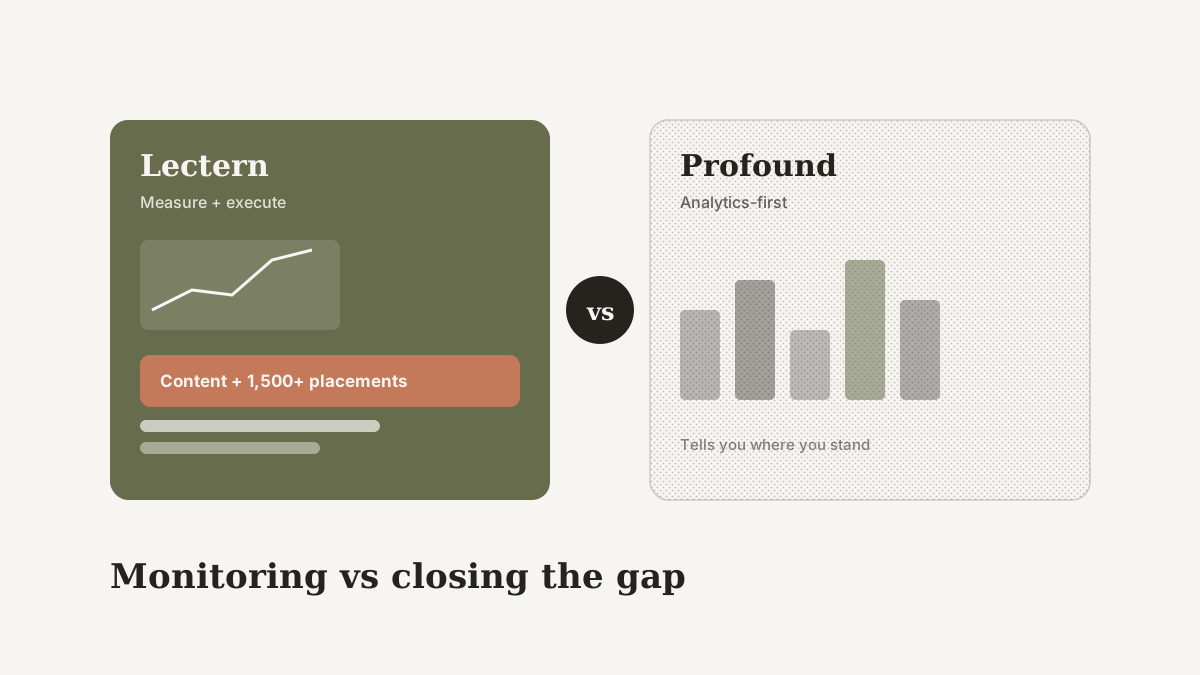
If you are weighing Profound alternatives, the real question is not which dashboard is prettier. It is whether you want a tool that reports your AI visibility or one that improves it. That single difference sorts the whole decision.
Short version: choose Profound if you want the category's deepest enterprise analytics and prompt-volume data. Choose Lectern if you want a tool that measures your AI visibility and then does the work to fix it with content and offsite placements. Profound's Enterprise tier tells you where you stand across up to ten AI engines (Starter is ChatGPT-only; Growth covers three). Lectern tells you where you stand and then closes the gap. Both are legitimate; they solve different problems.
One honest note before the detail: Profound is the more established name with a longer public customer list, and Lectern is newer. If a long roster of enterprise logos is your first filter, weigh that fairly.
Lectern vs Profound at a Glance
The table below is the whole argument in miniature. Profound is measurement-first with an analytics depth that is genuinely strong. Lectern is measurement plus execution, which is the axis most comparisons skip.
| Lectern | Profound | |
|---|---|---|
| Core model | Measure + execute | Analytics (+ marketing agents) |
| AI engines tracked | ChatGPT, Gemini, Perplexity, Claude, Grok, Meta AI | Up to 10 on Enterprise only; Starter is ChatGPT-only, Growth covers 3 |
| Closes the gap? | Content + offsite placements via 1,500+ publishers | Onsite assets and agents; no earned placements |
| Prompt-volume data | Priority-topic tracking | Deep prompt-volume dataset |
| Entry price | Free (Hobby); Pro $20/mo + usage | ~$99/mo self-serve (ChatGPT only) |
| Enterprise price | Custom | Custom; reported $2,000–$5,000+/mo |
| Works in your inbox | Email, Slack, Teams approvals | Dashboard-centric |
Prices verified from vendor and third-party sources as of July 2026 (see Sources). Read on, because "core model" is where the money decision actually lives.
What Profound Does Well
Profound is the incumbent for a reason. It describes itself as "a full stack marketing platform for the marketer of the future," and its analytics run deep. Its Enterprise tier tracks brand visibility across up to ten AI engines (Starter is ChatGPT-only; Growth covers three), surfaces prompt-volume data showing what millions of people actually ask AI, and monitors how AI crawlers like GPTBot access your site. Ramp is a named customer, and the platform has recently added "Agents" for autonomous marketing tasks plus an AEO-optimized FAQ generator.
If your team's job is to understand the AI-search landscape in granular detail, benchmark against competitors, and report it up the chain, Profound is one of the strongest tools you can buy. Its prompt dataset in particular is hard to match. For large organizations with an analyst who will act on the data, it earns its place on the shortlist.
Where Lectern Is Different
Lectern starts where most analytics tools stop. It measures visibility across ChatGPT, Gemini, Perplexity, Claude, Grok, and Meta AI, then builds an execution plan and runs it, producing onsite content and securing offsite placements through a network of 1,500+ publishers. The output is not a chart showing you are absent from AI answers; it is the coverage that gets you into them.
That execution layer traces back to the team's roots. Lectern is built by the people behind Presscart, with 2,000+ marketers and founders served and 5,000+ PR placements delivered. Approvals and progress flow through email, Slack, or Teams, so you review work rather than operate a dashboard. You can inspect the output before buying in the public report catalogue. For the strategy behind it, see what AEO is.
The Core Difference: Monitoring vs Closing the Gap
Profound recently added agents and content generation, so it is fair to say it is no longer pure analytics. But the execution it offers is onsite: FAQs, assets, and marketing tasks on properties you already own. Lectern's execution reaches offsite, to the third-party outlets AI models cite when they decide who to recommend.
This matters because of where AI citations come from. Analyses of AI answers repeatedly show that most brand mentions originate from third-party sources, not your own site, and comparison-style content is the most-cited format of all. You can optimize your homepage perfectly and still be invisible if the outlets AI trusts never mention you. Onsite work alone cannot manufacture that third-party coverage. That is the gap Lectern is built to close and the one a monitoring tool, however deep, leaves open.
Pricing Compared
Profound's pricing has grown less transparent over time. Self-serve references start around $99/mo, but that entry tier tracks ChatGPT only; real multi-engine coverage begins near $399/mo, and full enterprise deployments are custom quotes that third-party reviews place at $2,000–$5,000+/mo. Lectern is free on Hobby, $20/mo plus usage on Pro, and custom on Enterprise.
| Plan tier | Lectern | Profound |
|---|---|---|
| Free | Hobby (free forever) | Not offered |
| Entry | Pro $20/mo + usage | ~$99/mo (ChatGPT only) |
| Multi-engine | Included on Pro | ~$399/mo |
| Enterprise | Custom | Custom ($2,000–$5,000+/mo reported) |
Entry-price parity is not the point; what each dollar buys is. Profound's spend buys deeper analytics. Lectern's buys measurement plus the work to move the numbers.
Which Should You Choose?
Pick Profound if you are an enterprise that needs the deepest prompt-volume dataset, wants the most established brand in the category, and has an internal team ready to act on analytics. Pick Lectern if you want your AI visibility measured and improved without staffing that execution yourself, and you would rather approve content and placements from your inbox than manage another dashboard.
Many teams do not actually need both a monitoring suite and a separate execution function; they need one tool that carries the problem from diagnosis to result. If that describes you, Lectern is the more direct path. Also see Lectern vs Peec AI and Lectern vs Scrunch AI for the rest of the field.
Frequently Asked Questions
Is Lectern a good Profound alternative?
Yes, especially if your goal is to improve AI visibility rather than only measure it. Profound is analytics-first; Lectern measures across ChatGPT, Gemini, Perplexity, Claude, Grok, and Meta AI and then executes content and offsite placements to close the gaps it finds.
How much does Profound cost compared to Lectern?
Profound self-serve starts around $99/mo (ChatGPT only), rises to roughly $399/mo for multi-engine coverage, and is custom at the enterprise tier (reported $2,000–$5,000+/mo). Lectern is free on Hobby and $20/mo plus usage on Pro, with custom Enterprise pricing.
Does Profound create content or just track visibility?
Profound is primarily analytics but has added agents and an AEO FAQ generator, so it can produce some onsite assets. It does not secure offsite placements on third-party outlets. Lectern does both onsite content and offsite publisher placements.
Which AI engines does each tool track?
Profound tracks up to ten engines including ChatGPT, Gemini, Perplexity, Copilot, and Claude, but only on the Enterprise tier; Starter is ChatGPT-only and Growth covers three engines. Lectern tracks ChatGPT, Gemini, Perplexity, Claude, Grok, and Meta AI on every paid plan. Both cover the models most buyers care about.
Is Profound better for enterprise?
Profound has a longer public enterprise track record and a deeper analytics dataset, so it is a natural enterprise shortlist entry. Lectern serves growth-stage and enterprise brands too, and wins when the priority is closing the visibility gap, not only reporting it. Run an AI visibility audit to see which problem you actually have.
Bottom Line
Profound is the deeper analytics platform. Lectern is the one that measures and moves your AI visibility. If you have the internal team and want the richest dataset, Profound is a strong choice. If you want the gap actually closed, with the work approved through your inbox, Lectern is the better fit. Browse the public reports to see the output before you decide.
Sources
- Profound product, positioning, and engine coverage: tryprofound.com.
- Profound pricing reporting: Trakkr, G2.
- AI-citation format data: Search Engine Land; Peec AI 232k-citation study.
Lectern helps growth-stage brands get recommended by AI assistants. We measure how you show up across ChatGPT, Gemini, Perplexity, Claude, Grok, and Meta AI, then close the gap with content and publisher placements. See pricing or browse public reports.
Written by

Edgar Li
Cofounder at LecternEdgar is a cofounder at Lectern, helping growth-stage companies teach AI models to accurately represent and recommend their products - turning that visibility into high-intent traffic and revenue. A product builder who thinks in narrative and customer value, he now applies that lens to helping founders win in AI search.