AI Visibility: The Complete Guide to Getting Recommended by AI
AI search has created a new gatekeeper between your brand and your buyers.
Traditional search ranks pages. AI systems assemble answers, compare options, and recommend the brands they consider credible. That changes the job for marketers.
Ranking still matters. But ranking alone does not guarantee that ChatGPT, Claude, Perplexity, Gemini, or Google AI Overviews will cite your content—or recommend your company.
The commercial opportunity is already meaningful. Similarweb estimated that AI platforms generated more than 1.1 billion referral visits in June 2025, up 357% year over year. That remains small beside Google's referral volume, but the direction is clear: buyers are adding AI assistants to how they discover and evaluate companies. Similarweb
This guide explains how AI visibility works, why traditional SEO only gets you part of the way there, and how to build a system that moves your brand from invisible to cited—and from cited to recommended.
What Is AI Visibility?
AI visibility measures whether AI systems mention your brand, cite your content, describe you accurately, and recommend you for the questions that matter to your business.
AEO—answer engine optimization—is the work you do to improve that visibility.
The terminology can become distracting. AEO, GEO, LLMO, and AI search optimization all describe overlapping practices. The more useful distinction is between four outcomes:
- A mention means your brand appears somewhere in the answer.
- A citation means the system uses your content or another source about you as evidence.
- An accurate narrative means the system understands what you do and who you serve.
- A recommendation means the system actively presents your brand as a credible choice.
That final step matters most.
A brand can appear in an answer without making the shortlist. It can be cited for a definition without being recommended as a provider. It can even be described using outdated or incomplete information.
We call the distance between those outcomes the recommendation gap.
Closing that gap is the real objective of AEO.
Why AI Visibility Deserves Its Own Strategy
AI discovery is not replacing traditional search overnight. It is adding a new decision layer before the click.
A buyer may ask an AI assistant to explain a category, compare vendors, identify tradeoffs, and build a shortlist before visiting a single company website. By the time that buyer reaches you, much of the evaluation has already happened.
That makes AI visibility an upstream revenue signal.
The direct referral traffic is only one part of the value. AI recommendations can also lead to branded searches, direct visits, source clicks, and later conversions that analytics platforms attribute to another channel.
Consumers still verify what AI tells them. Yext's 2026 research found that more than 93% of AI users take at least one additional step before acting: searching Google, visiting the company's website, reading reviews, or opening cited sources. Yext
That creates three risks for brands:
- You are absent. Competitors enter the conversation and you do not.
- You are misunderstood. AI describes the wrong product, audience, or differentiator.
- You are unsupported. Your website makes the claim, but independent sources do not validate it.
Traditional SEO can help with the first problem. It does not solve all three.
How AI Systems Build Answers
There is no single AI-search algorithm. Each platform uses its own models, indexes, retrieval partners, and source-selection systems.
The underlying process is broadly similar:
- Interpret the user's question.
- Expand it into related searches or sub-questions.
- Retrieve relevant sources.
- Extract useful passages and facts.
- Compare evidence across sources.
- Synthesize an answer and select citations.
Some knowledge comes from model training. Increasingly, current answers also rely on live retrieval or retrieval-augmented generation.
Google, for example, says its generative search features use retrieval-augmented generation grounded in its existing Search index and ranking systems. Google Search Central
The practical implication is straightforward: your brand needs to be both retrievable and credible.
AI systems need to find clear information about you. They also need enough consistent evidence to repeat that information confidently.
Your website can say you are the best solution in your category. Independent publications, directories, customers, reviewers, and experts make that claim safer for an AI system to repeat.
That is why AI visibility extends beyond on-page optimization.
AEO and Traditional SEO: What Changes?
AEO builds on SEO. It does not replace it.
Google explicitly says established SEO practices continue to matter in its generative search experiences. Strong content, crawlability, authority, and technical health remain foundational. Google Search Central
The difference is the outcome you are optimizing for.
| Traditional SEO | AI visibility |
|---|---|
| Ranks pages | Influences generated answers |
| Targets search positions | Targets citations and recommendations |
| Measures clicks and impressions | Measures mentions, citations, narrative, and share of voice |
| Builds authority around a domain | Builds confidence around a brand or entity |
| Prioritizes content people can scan | Prioritizes passages AI systems can extract accurately |
| Relies heavily on owned content and backlinks | Also depends on consistent third-party attribution |
Good SEO helps AI systems discover you. AEO helps them understand when and why they should choose you.
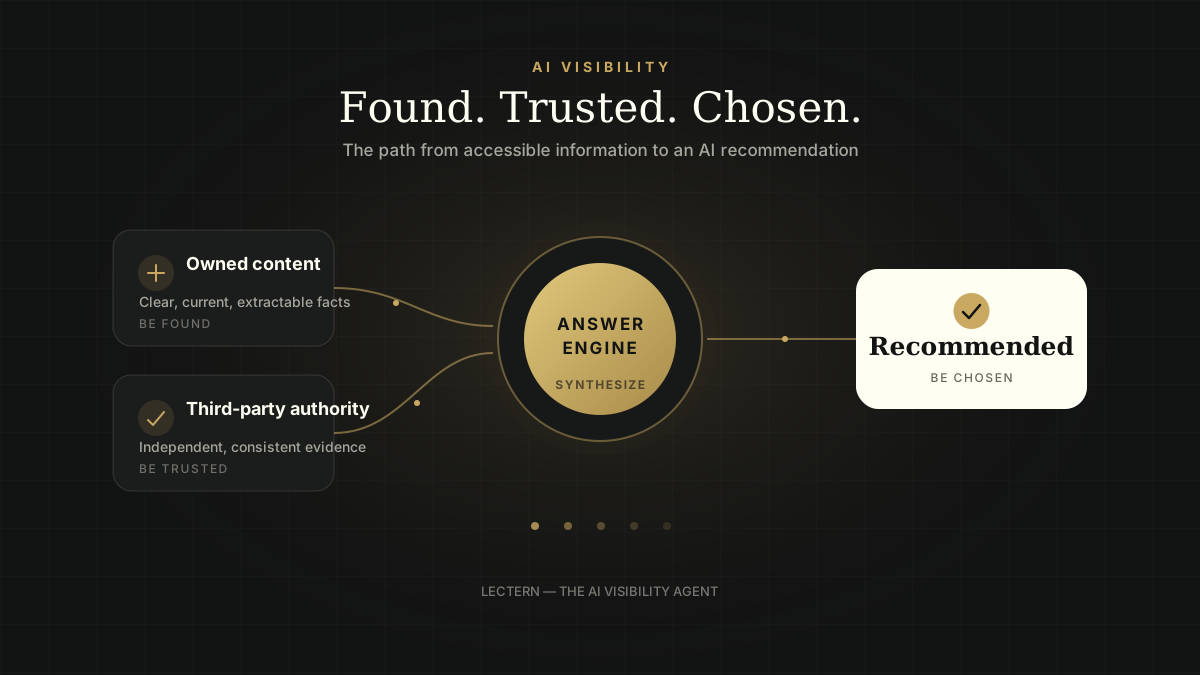
The Lectern Framework: Be Found. Be Trusted. Be Chosen.
A durable AI visibility strategy has three layers.
Layer 1: Be Found
First, make your owned content accessible, understandable, and easy to extract.
Check Crawler Access
Audit your robots.txt, noindex directives, CDN, and firewall rules. A perfectly written page cannot be cited if the relevant search systems cannot retrieve it.
The crawler names matter:
- OpenAI uses OAI-SearchBot for content that may appear in ChatGPT search summaries and citations. GPTBot serves a different purpose. OpenAI
- Anthropic distinguishes between Claude-SearchBot, Claude-User, and the training-focused ClaudeBot. Anthropic
- Perplexity recommends allowing PerplexityBot if you want content surfaced in its search results. Perplexity
- Google's AI search features rely on the Google Search index. Google-Extended is a separate control for Gemini training and grounding; it does not control inclusion or ranking in Google Search. Google
Review both robots.txt and any bot-protection layer. Many access problems happen at the firewall, not in the file.
Structure Content Around Real Questions
Create pages that answer the questions buyers actually ask:
- What is this category?
- Which products are best for a specific use case?
- How do the leading options compare?
- What does implementation require?
- What are the limitations or tradeoffs?
- Who is this product not right for?
Put a concise answer near the beginning of each section. Use descriptive headings, short paragraphs, comparison tables, and numbered steps where they improve clarity.
Each section should remain useful when extracted from the rest of the page.
Give AI Systems Evidence to Quote
Generic claims are difficult to cite. Specific evidence is easier to use.
Include:
- Original research
- Clear methodologies
- Customer results
- Product specifications
- Named expert commentary
- Dates and authors
- Links to primary sources
- Concrete examples and limitations
Do not invent precision. A smaller number of defensible facts is more valuable than a page filled with unsupported statistics.
Make Your Brand Entity Unambiguous
Use the same company name, product description, category, audience, and core claims across your website.
Add appropriate organization, article, product, author, and FAQ structured data where it accurately represents the page. Schema will not manufacture authority, but it can make relationships and page meaning easier to interpret.
Keep Important Pages Current
AI systems frequently answer questions where recency matters. Review category pages, comparisons, statistics, pricing references, and product documentation on a defined schedule.
A visible “last updated” date helps only when the content has genuinely been reviewed.
Layer 2: Be Trusted
Owned content explains your position. Third-party attribution validates it.
This is where many AEO strategies stop too early. They improve headings, publish FAQs, and wait for citations to appear.
But AI systems do not only evaluate what you say about yourself. They encounter your brand across publications, review platforms, directories, social discussions, podcasts, videos, and comparison pages.
When those sources repeatedly connect your brand with the same category and capabilities, your narrative becomes easier to verify.
Audit the Sources Behind Competitor Recommendations
Run your priority questions across the major AI platforms and record:
- Which competitors appear
- Which competitors are recommended
- Which sources support those recommendations
- Which claims are repeated
- Which publications or directories appear most often
- Where your brand is missing
This turns “we need more authority” into a concrete source map. If you need a repeatable baseline, start with the five-level AI visibility audit.
Earn Topic-Aligned Third-Party Coverage
Prioritize sources that are both credible and relevant to the question you want to win.
That can include:
- Industry publications
- Expert roundups and comparison pages
- Customer case studies
- Review platforms
- Professional directories
- Podcasts and webinars
- Research partnerships
- Thought leadership from company experts
The objective is not to manufacture mentions. It is to build a consistent body of independent evidence around what your company genuinely does well.
Keep Your Narrative Consistent
AI systems reconcile information from multiple sources. Conflicting descriptions weaken confidence.
Your website may describe you as an enterprise platform while directories call you a small-business tool. An old interview may position the company around a product you no longer sell. Review sites may use the wrong category.
Audit these discrepancies and correct the sources you control. For sources you do not control, create stronger and more current evidence.
Layer 3: Be Chosen
Measurement should tell you what to fix—not merely produce another dashboard.
Start with a stable set of priority queries tied to real buying situations. Test them across ChatGPT, Claude, Perplexity, Gemini, and Google's AI experiences.
Track at least six metrics:
- Citation rate: How often does your brand or content appear as a source?
- Recommendation rate: How often are you actively presented as a suitable option?
- Share of voice: How often do you appear relative to named competitors?
- Narrative accuracy: Does the answer describe your category and capabilities correctly?
- Source diversity: How many independent domains support your position?
- Business impact: What referral visits, branded searches, assisted conversions, and revenue follow?
Do not collapse these into a single visibility score without preserving the underlying evidence. A rising score means little if AI systems are still describing the brand incorrectly.
Use a practical cadence:
- Weekly: Spot-check high-value questions and investigate major changes.
- Monthly: Run the full query set, compare competitors, and identify new source gaps.
- Quarterly: Refresh content, update the authority plan, and connect visibility changes to commercial results.
Google has also begun testing dedicated generative-AI performance reporting in Search Console, which can supplement your cross-platform measurement where available. Google Search Central
For a closer look at sampling and measurement, read how to track brand mentions in ChatGPT without guessing.
Where Should You Start?
Your starting point depends on your current maturity.
If Your SEO Foundation Is Weak
Fix crawlability, indexing, site structure, and core category content first. AI visibility work cannot compensate for a site that search systems cannot reliably access or understand.
If You Rank Well but AI Ignores You
Investigate your third-party attribution.
Search visibility proves that a page is relevant. It does not necessarily prove that your brand deserves to be recommended. Compare your external source footprint with the competitors that AI systems select.
If You Are Cited but Not Recommended
You have a recommendation-gap problem.
Review which capabilities AI associates with your brand, which use cases trigger a recommendation, and what evidence supports competitors instead. You may need stronger comparison content, clearer positioning, or more independent validation.
If You Are Already Recommended
Defend and expand your share of voice.
Track more buyer questions, strengthen weak topics, refresh source coverage, and monitor whether the narrative changes as competitors enter the category.
A Practical Way to Begin
You do not need hundreds of queries or dozens of new articles on day one.
Start with five steps:
- Choose 20 questions that represent real discovery, comparison, and purchase decisions.
- Run those questions across the major AI platforms.
- Record mentions, recommendations, competitors, citations, and narrative errors.
- Select the most valuable gap and launch one owned-content campaign plus one third-party authority campaign.
- Rerun the same questions monthly and measure the change.
The first audit gives you a baseline. The source analysis tells you why the gap exists. The campaign creates the evidence needed to close it.
That is the difference between monitoring AI visibility and improving it.
AI Visibility Is an Operating System, Not a One-Time Project
AI platforms, retrieval systems, competitors, and source preferences will keep changing.
The brands that win will not be the ones that discover a single formatting trick. They will be the ones that build a repeatable loop:
Audit the answers. Find the evidence gap. Create the right content. Earn independent authority. Measure whether the recommendation changes.
Traditional SEO helps your pages get found.
AEO helps your brand get understood, cited, and recommended.
That is the new standard for visibility.
Browse Lectern's public AI visibility reports to see how brands and competitors appear across the major answer engines—or get in touch to run an audit for your category.
Written by

Edgar Li
Cofounder at LecternEdgar is a cofounder at Lectern, helping growth-stage companies teach AI models to accurately represent and recommend their products - turning that visibility into high-intent traffic and revenue. A product builder who thinks in narrative and customer value, he now applies that lens to helping founders win in AI search.